Dagbamba Youth Association Engages NaCCA to Challenge Historical Misrepresentations of Dagbon History
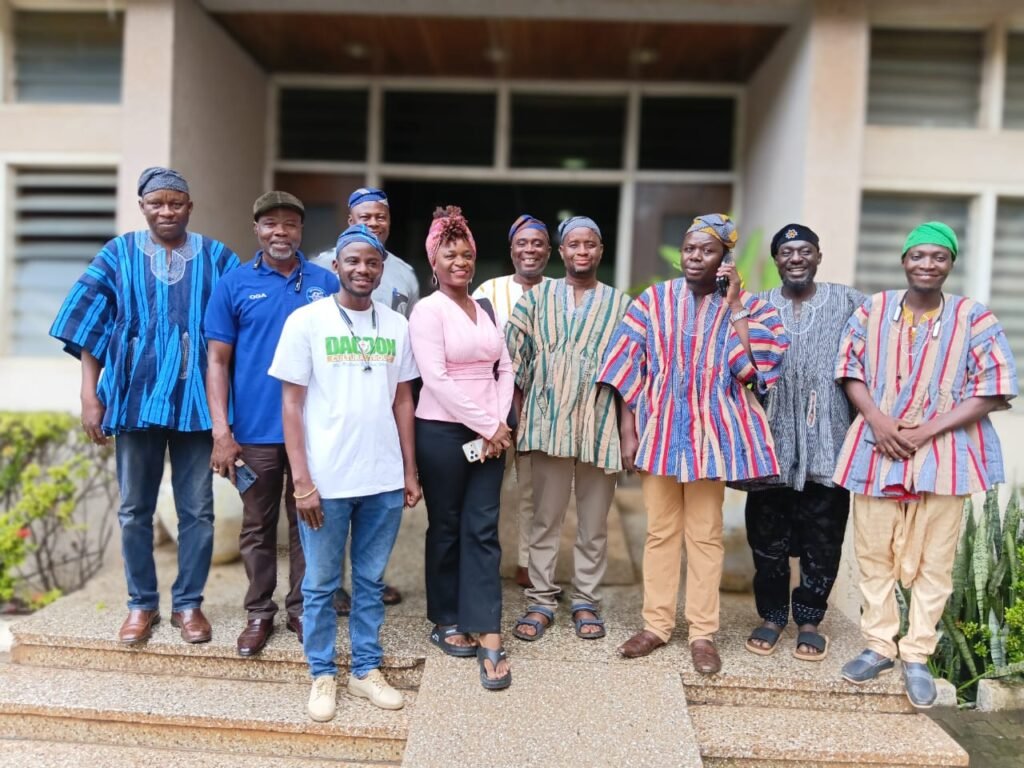
The Dagbamba Youth Association (DAYA), led by Abubakari Is haq Motariga and supported by legal counsel Lawyer Jeliu Issahaku Sapaschini, on Tuesday engaged the National Council for Curriculum and Assessment (NaCCA) in a landmark meeting aimed at addressing what the association describes as decades of historical inaccuracies, myths, and colonial-era distortions regarding the history and heritage of the Dagbamba people.
The delegation included former Ghanaian Ambassador to Turkey, Alhaji Ibrahim Abass, Prof. Abdullahi Salifu Asuro, Hon. Hardi Pagazaa, Alhaji Jagbo Baako, Lung Pagabia Abdul Razak, Gumani Lun Naa Umar, Mr Alhassan Abdullai, Mr Yakubu Fusheini, Mr Ibrahim Alhassan, Ziblila Bawa, and Mr Alhassan Fatawu. Ms Huzeima Mahamadu was the female representative on the delegation. Together, they represented a diverse group of academics, traditional historians, drummers, legal experts, researchers, diaspora voices, and community stakeholders committed to preserving, documenting, and promoting the authentic history and heritage of the Dagbamba people.
Challenging Colonial-Era Narratives
According to DAYA, many narratives currently found in Ghana’s educational curriculum originated from colonial-era writings and accounts provided by non-Dagbamba informants, particularly Hausa scholars. These accounts were subsequently adopted by academics and educational institutions without sufficient consultation with Dagbamba traditional historians and custodians of oral history.
The association argued that while certain narratives have become dominant through repeated citation, popularity does not automatically make them historically authentic.
“Oral traditions are critical sources of African identity and knowledge,” representatives stated during the engagement. “Failure to critically engage authentic oral sources results in the silencing of African histories and perspectives.”
In Dagbon tradition, drummers serve as custodians of historical knowledge, preserving and transmitting collective memory across generations. DAYA maintained that these oral records remain vital sources for understanding the true history of the Dagbamba people.
Resolution 1: Rejection of the Toha Zei Narrative
One of the key issues raised concerned the widely circulated narrative that the Dagbamba originated from the Lake Chad region and were led by a mythical ancestor known as Toha Zei, often referred to as the “Red Hunter.”
DAYA noted that NaCCA-accredited materials, including basic school history textbooks and senior high school history manuals, continue to present this account as historical fact.
However, the association cited research commissioned by Ghana’s National House of Chiefs between 2000 and 2002, which reportedly found no evidence of Toha Zei in Dagbon drum traditions. According to the findings, Toha Zei belongs to a broader West African mythical tradition and cannot be verified as a historical founder of Dagbon. The committee therefore unanimously resolved that the Toha Zei narrative should be removed from all NaCCA-accredited educational materials and replaced with the historical position that Naa Nimbu is the founding father of the Dagbamba people.
Resolution 2: Indigenous Origins of the Dagbamba People
DAYA further challenged the assertion that the Dagbamba migrated from Chad into present-day Ghana. The association argued that linguistic, cultural, archaeological, and oral historical evidence support the view that the Dagbamba are indigenous to the Voltaic Basin and descendants of ancient populations that occupied the area through the Stone and Iron Ages. Reference was made to the Mabia linguistic classification developed by Professor Adams Bodomo, which links Dagomba, Frafra, Kusaal, Builsa, Talensi, Nabdam, and related groups through a shared linguistic and cultural heritage rooted in the Voltaic Basin. DAYA emphasised that Dagbon oral traditions themselves acknowledge that the Gbewaa lineage encountered indigenous populations already inhabiting the territory, with the Dagomba Kingdom emerging through gradual assimilation and intermarriage rather than conquest or displacement.
Resolution 3: Contesting the Ashanti Conquest Narrative
Another major issue raised during the engagement was the longstanding narrative that the Ashanti Kingdom conquered Dagbon during the reign of Opoku Ware I around 1744. Representatives of DAYA argued that this account is not supported by Dagomba oral traditions, drum histories, or testimonies from traditional historians. According to the association, oral records indicate that Naa Gariba was never arrested by the Ashanti and that relations between Dagbon and Asanteman were primarily diplomatic and commercial.
The committee cited traditions surrounding the Gungumle (Kapok Pod) narrative and testimonies from respected drummers, which describe cooperation and mutual support between the two kingdoms rather than military confrontation. Furthermore, DAYA referenced statements acknowledging longstanding intermarriage and cultural ties between the Dagomba and Ashanti peoples. The committee unanimously resolved that the claim of an Ashanti conquest of Dagbon is a fabricated narrative that should be removed from educational materials and replaced with a more accurate account reflecting diplomatic, political, and trade relations between the two kingdoms.
Resolution 4: Challenging the Gonja Invasion Narrative
The association also rejected historical accounts claiming that the Gonja Kingdom, under Ndewura Jakpa, invaded Dagbon, killed Naa Darizegu, displaced Dagomba populations, and ruled over them until Ghana’s independence.
DAYA presented oral historical evidence suggesting that Naa Darizegu died in Gonja territory at Daboya and that the figure known as Jakpa does not appear in Dagbon drum chants associated with those events. The committee further argued that the relocation of the Dagbon capital to Yendi was a sovereign political decision rather than a consequence of military defeat. In addition, representatives questioned the reliability of the Kitaab Gbunja, a source frequently cited in support of the invasion narrative. The committee unanimously resolved that the Gonja conquest narrative lacks sufficient historical support and should therefore be removed from NaCCA-accredited curriculum materials.
Call for Historical Revision and Curriculum Review
In concluding the engagement, DAYA emphasised that the disputed narratives did not originate from Dagbamba drummers, elders, or traditional historians but rather emerged from colonial-era accounts that were subsequently reproduced through academic literature and eventually incorporated into Ghana’s national curriculum. The association urged NaCCA to critically review the available evidence, including research by the National House of Chiefs, field studies by scholars, and testimonies from traditional custodians of Dagbon history.
“We are not asking NaCCA to accept our claims without scrutiny,” representatives stated. “We are asking that the evidence be examined fairly and that historical accuracy guide curriculum development.”
The group expressed concern that generations of Dagomba students continue to encounter narratives they believe misrepresent their ancestry, identity, and historical origins. As the meeting concluded, DAYA thanked NaCCA officials for their willingness to engage in dialogue and expressed optimism that the concerns raised would contribute to a more balanced and evidence-based representation of Dagbon history in Ghana’s educational system.
Reference Document
For details on the engagement and various critical issues raised, click the link below:
I hereby confirm that the names Huzeima Mahamadu and Huzaima Mahamadu appearing on the document refer to one and the same person. The discrepancy arises solely from a variation in the name’s spelling. For official and academic purposes the name is spelled Huzeima Mahamadu.
Note:
This article reports on resolutions and positions presented by the Dagbamba Youth Association (DAYA) during its engagement with the National Council for Curriculum and Assessment (NaCCA) on June 9, 2026. The historical interpretations and claims contained herein reflect the views, oral traditions, research findings, and submissions advanced by DAYA and its representatives. Some of the issues raised concern long-standing historical debates and interpretations that may be viewed differently by other scholars, traditional authorities, and historical sources. The purpose of this report is to document the proceedings and recommendations presented to NaCCA as part of an ongoing national conversation on the representation of Dagbon history in Ghana’s educational curriculum.
By: Huzeima Mahamadu