
Enslavement as the Gravest Crime Against Humanity: Who Bears Responsibility?
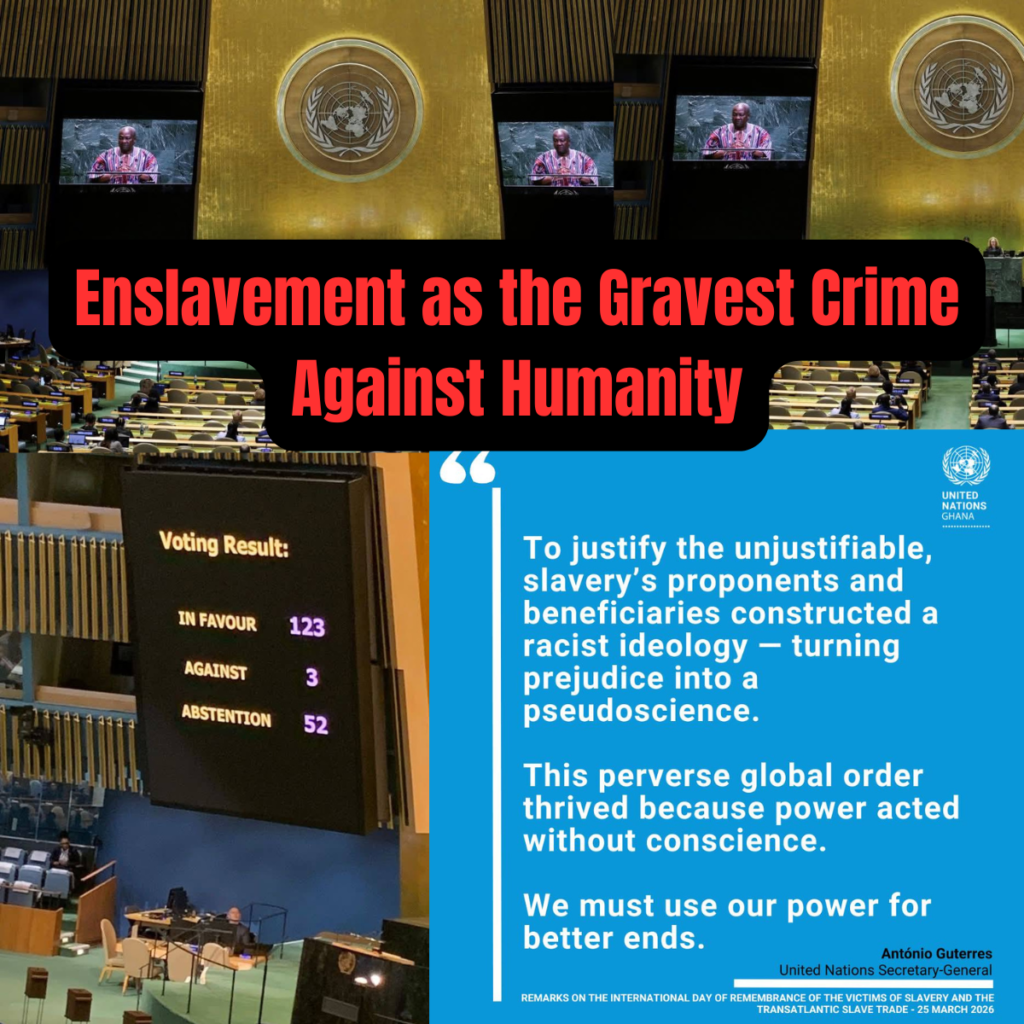
Since 2007, 25 March has been designated as the International Day of Remembrance of the Victims of Slavery and the Transatlantic Slave Trade. It is therefore fitting that the United Nations General Assembly adopted the resolution, “Declaration of the Trafficking of Enslaved Africans and Racialised Chattel Enslavement of Africans as the Gravest Crime Against Humanity,” on this same date.
The adoption of this resolution, in which 123 countries supported the recognition of enslavement as “the gravest crime against humanity,” is long overdue. Perhaps now, the restless spirits of African ancestors, long lingering in the shadow of injustice, may begin to find some measure of peace. The world has, at last, admitted that what they endured was not merely wrong, but among the most inhumane acts ever inflicted by one human upon another, despite the abstention of much of Europe and the opposition of countries such as Argentina, Israel, and the United States.
For me, as a Ghanaian and a researcher of enslavement, March 25, 2026, marks a historic moment, not only for African descendants, but for all who recognise and uphold the dignity of humanity. Though this recognition comes centuries late, over 500 years since the crime began, and nearly 200 years of denial and reluctance by many implicated nations to offer full apologies. It nonetheless establishes a moral foundation upon which demands for justice and accountability can stand.
I support the leadership of Ghana’s president, His Excellency John Dramani Mahama, in advancing this resolution. However, my focus is not primarily on monetary reparations. Rather, I turn inward, to Ghana itself, where many still have limited experiential engagement with the realities of enslavement. That is where the conversation must begin.
Before the fifteenth century, the people of present-day West Africa, including Ghana, were free. They lived with dignity, aspiration, and ingenuity. They cultivated the land, developed technologies suited to their environments, created art of remarkable sophistication, and engaged in vibrant systems of trade and commerce. They built homes, wore finely woven textiles, adorned themselves with gold and beads, and expressed their worldview through culture and creativity. In simple terms, they were a civilised society before the arrival of the Europeans. If this image feels distant, one need only reflect on the wealth and influence of Mansa Musa and his famous pilgrimage to Mecca in the 14th century to understand the prosperity and humanity that characterised African societies before the disruption of chattel slavery.
The arrival of Europeans in the fifteenth century and the transformation of the Gold Coast into the Slave Coast by the seventeenth century marked a devastating rupture. Millions of young, free, and capable Africans were captured, displaced, and forcibly transported across the Atlantic into systems of brutal exploitation. The enduring question remains: who is guilty and who is responsible?
Enslavement was driven fundamentally by economic motives, sustained by systems of domination and ideologies of otherness. European powers created the demand for large-scale African labour, particularly for plantation economies in the Americas, and engineered systems to meet that demand. Thus, the European nations primarily designed, financed, and benefited from this global system of exploitation and are therefore responsible for it.
At the same time, it is necessary to acknowledge the participation of some African intermediaries, a few chiefs and merchants from specific ethnic groups who, under varying conditions of coercion, deception, and economic pressure and greed, contributed to its success. Many captives died before even reaching the coast; others perished in the dungeons, during the Middle Passage, or under the cruelty of enslavement in the Americas. These internal dynamics, however, must be understood within the broader structure of European domination, manipulation, and the creation of demand, not as equal culpability, but as part of a complex and tragic system.
The legacy of enslavement is not confined to the past; it is a living history. Its imprint can be seen in global racial hierarchies, economic inequalities, colonial and neocolonial systems, and the persistent marginalisation of African peoples. As echoed by many voices in the United Nations General Assembly on March 25 2026, these legacies continue to shape the world we inhabit today.
Yet, while acknowledging these injustices, I argue that Africa’s path forward cannot rest solely on demands for monetary reparations. What Africa needs is a fairer global system, equitable trade, just financial policies, and an end to the continued exploitation of its natural resources. However, beyond these external conditions lies an internal responsibility.
Africa must look inward. No nation will prioritise Africa’s interests above its own. The responsibility to transform the continent rests primarily with Africans themselves. While we are not guilty of the gravest crime committed against humanity, we bear a profound responsibility to shape our future, to build institutions, strengthen economies, and create conditions for sustainable development.
Power in the global arena is not granted; it is built. And without economic and political strength, participation risks becoming symbolic rather than substantive. A nation that lacks power is often invited to the table only to complete the appearance of inclusion, not to shape decisions.
Therefore, let us not place our hopes solely in external forces. No one will abandon their own challenges to resolve ours. The recognition of enslavement as the gravest crime against humanity is a significant moral victory, but it must also serve as a call to action.
A call not only for justice, but for responsibility.
Not only for remembrance, but for renewal.
Not only for the past, but for the future.
Huzeima Mahamadu (PhD Candidate, Australian National University, Australia)